Natural Sciences in English · 01
Quadratic Equations and Parabolas — read the maths, speak the maths
Why this lesson? You already know 一元二次方程 and 抛物线 in Chinese. This lesson gives you the exact English for the same ideas — the words, the notation, and how to read equations aloud. Every symbol you meet here is one you will see again in every English textbook.
1. What is a quadratic equation?
A quadratic equation is any equation that can be written in the standard form
ax² + bx + c = 0, where a ≠ 0
Read it aloud: "a x squared plus b x plus c equals zero, where a is not equal to zero."
The name comes from the Latin quadratus, meaning "square" — because the highest power of the variable is x squared. That is why the condition a ≠ 0 matters: if a were zero, the equation would become bx + c = 0, which is linear, not quadratic.
2. The graph: a parabola
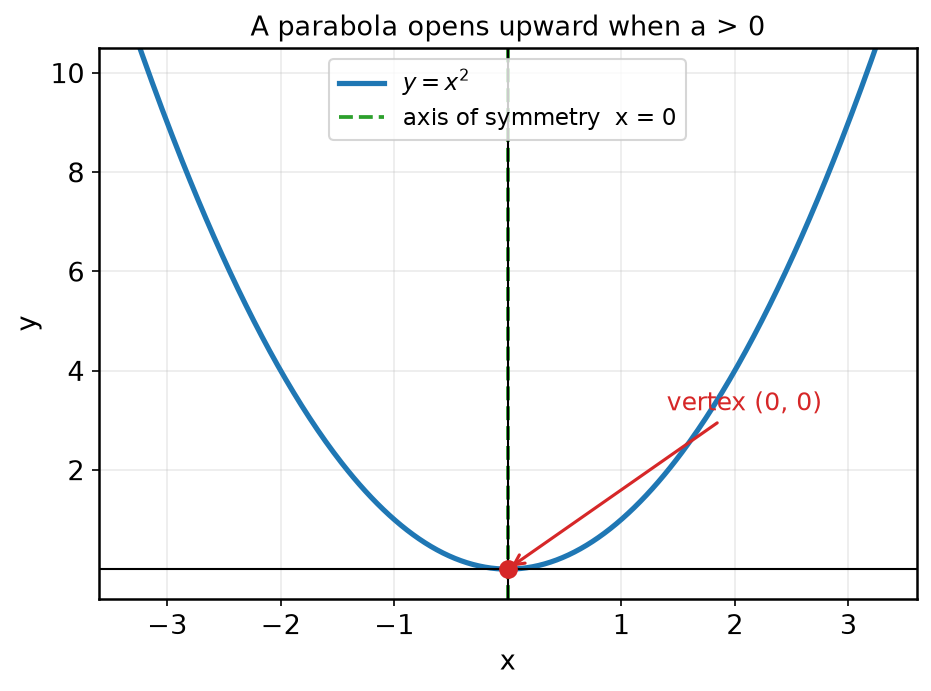
The graph of any quadratic function y = ax² + bx + c is a smooth, symmetric curve called a parabola. Two features define its shape:
- Opening direction — if a > 0, the parabola opens upward (like a cup); if a < 0, it opens downward (like a cap).
- Vertex — the highest or lowest point of the curve, the point where it turns around.
- Axis of symmetry — a vertical line through the vertex; the left half of the curve is the mirror image of the right half.
3. Solving a quadratic equation — three methods
There are three standard ways to solve ax² + bx + c = 0. In an English exam or textbook you must recognise all three.
Method 1 · Factorisation (因式分解)
If the left-hand side can be written as a product of two brackets, the equation is easy to solve. For example:
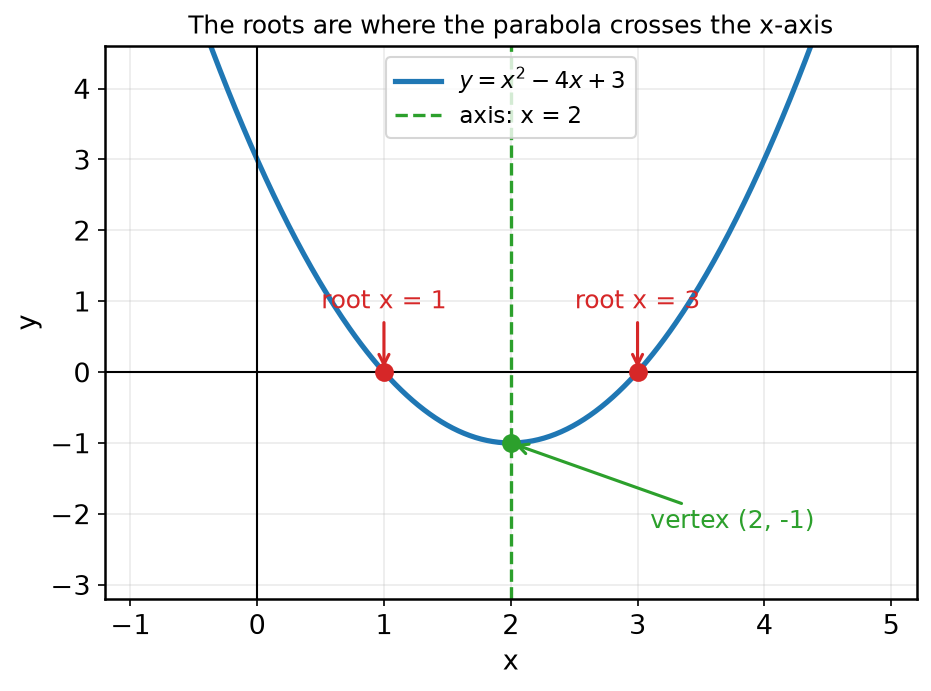
x² − 4x + 3 = 0
(x − 1)(x − 3) = 0
x = 1  or  x = 3
Read it: "x squared minus four x plus three equals zero. Factorise: x minus one times x minus three equals zero. Therefore x equals one or x equals three."
The reasoning uses the zero-product property: if the product of two numbers is zero, then at least one of them must be zero.
Method 2 · Completing the square (配方法)
We rewrite the equation so the x-terms form a perfect square. This method is important because it derives the quadratic formula and gives you the vertex directly.
x² − 4x + 3 = 0
x² − 4x = −3
x² − 4x + 4 = 1
(x − 2)² = 1
x − 2 = ±1
x = 3  or  x = 1
Notice the step "x squared minus four x plus four equals one": we added 4 to both sides, which is the square of half of −4. The phrase you will hear in English classes: "take half the coefficient of x, square it, and add it to both sides."
Method 3 · The quadratic formula (求根公式)
For any quadratic, the two solutions are given by
x = (−b ± √(b² − 4ac)) / 2a
Read it aloud: "x equals minus b plus or minus the square root of b squared minus four a c, all over two a."
This formula always works, even when factorisation is difficult or impossible.
4. The discriminant and the number of roots
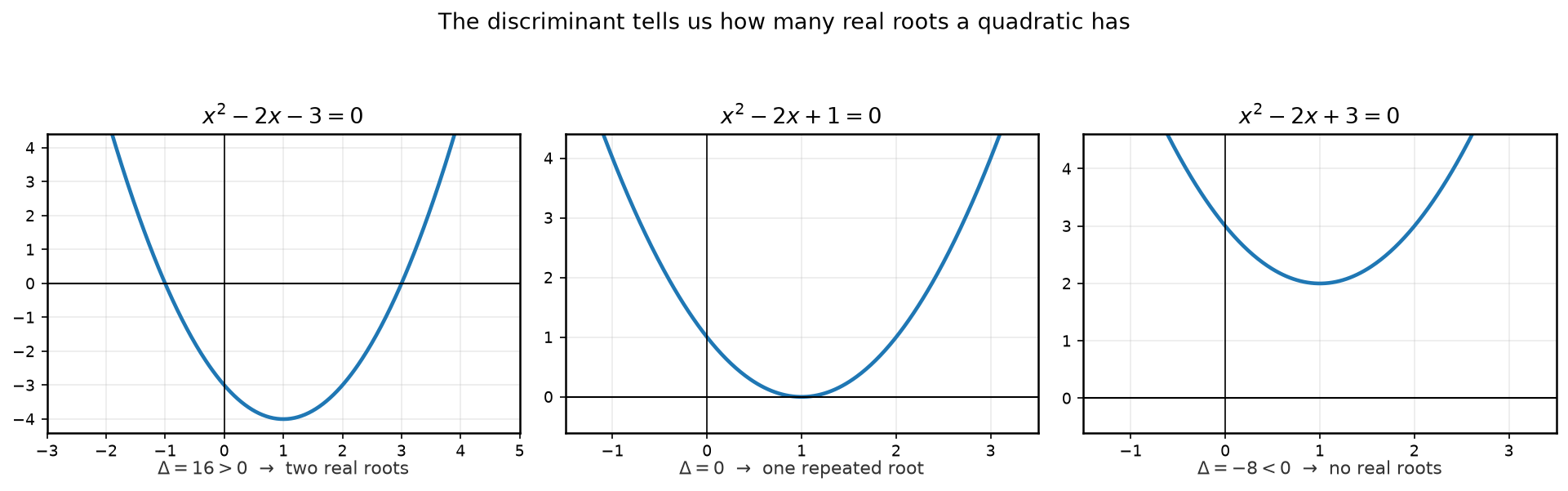
The expression under the square root, Δ = b² − 4ac, is called the discriminant (判别式). The word itself is useful: it comes from the Latin discriminare, "to distinguish" — because it distinguishes between the three cases:
| Discriminant | Number of real roots | Meaning |
|---|---|---|
| Δ > 0 | two distinct real roots | the parabola crosses the x-axis twice |
| Δ = 0 | one repeated root | the parabola just touches the x-axis (its vertex sits on the axis) |
| Δ < 0 | no real roots | the parabola never touches the x-axis; the roots are complex |
5. Vertex and axis of symmetry
For y = ax² + bx + c, the x-coordinate of the vertex is always
x = −b / 2a
Read it: "x equals minus b over two a." The axis of symmetry is the vertical line through this point. The y-coordinate is found by substituting this x back into the equation — in English, "plug it back in" or "substitute it back."
6. Where quadratics appear in real life
Quadratics are everywhere, and IELTS-style reading passages about science love these examples:
- Projectile motion (抛体运动) — the height of a thrown ball follows a parabola as gravity pulls it back down.
- Area problems — fencing a rectangular field with a fixed length of fence gives a quadratic for the maximum area.
- Profit maximisation — a company's profit as a function of price is often a downward-opening parabola; the vertex is the profit-maximising price.
7. Worked example — full English solution
Problem. Solve 2x² − 5x + 2 = 0 and describe its graph.
Solution. First we compute the discriminant:
Δ = b² − 4ac = (−5)² − 4·2·2 = 25 − 16 = 9 > 0
"Delta equals b squared minus four a c, which is twenty-five minus sixteen, which is nine — greater than zero."
Since Δ > 0, there are two distinct real roots. Using the quadratic formula:
x = (5 ± √9) / 4 = (5 ± 3) / 4
x = 2  or  x = 1/2
"x equals five plus or minus the square root of nine, over four. So x equals two, or x equals one half."
Because a = 2 > 0, the parabola opens upward. Its vertex is at x = −b/2a = 5/4, and it crosses the x-axis at x = 1/2 and x = 2.
8. Quick check — test yourself
- What is the discriminant of x² + 6x + 9 = 0, and how many real roots does it have?
- For y = −x² + 4x, does the parabola open upward or downward, and what is the vertex?
- Translate into English: "该抛物线开口向下,顶点在 (2, 4),且与 x 轴有两个交点。"
Answers: 1. Δ = 36 − 36 = 0, one repeated root (x = −3). 2. a = −1 < 0, opens downward; vertex x = −4/(2·−1) = 2, y = −4 + 8 = 4, so (2, 4). 3. "The parabola opens downward, its vertex is at (2, 4), and it intersects the x-axis at two points."
9. Vocabulary recap
| Term | Meaning |
|---|---|
| quadratic | involving x²; from Latin "square" |
| parabola | the U-shaped graph of a quadratic |
| vertex | the turning point; highest or lowest point |
| axis of symmetry | the mirror line through the vertex |
| root / solution | a value of x that makes the equation true |
| discriminant | b² − 4ac; decides the number of roots |
| factorise / factor | write as a product of brackets |
| complete the square | rewrite to form a perfect square |
| substitute / plug in | replace a variable with a value |
| trajectory | the curved path of a moving object |
No comments yet.