Natural Sciences in English · 02
Coordinate Geometry: Lines and Circles — the English of the Cartesian plane
Why this lesson? In Chinese you know this as 平面解析几何 — turning shapes into equations. This lesson teaches the same ideas in English: how to name the plane, how to read a line equation aloud, and how to describe circles, distance and midpoints in the words examiners and textbooks use.
1. The Cartesian coordinate plane
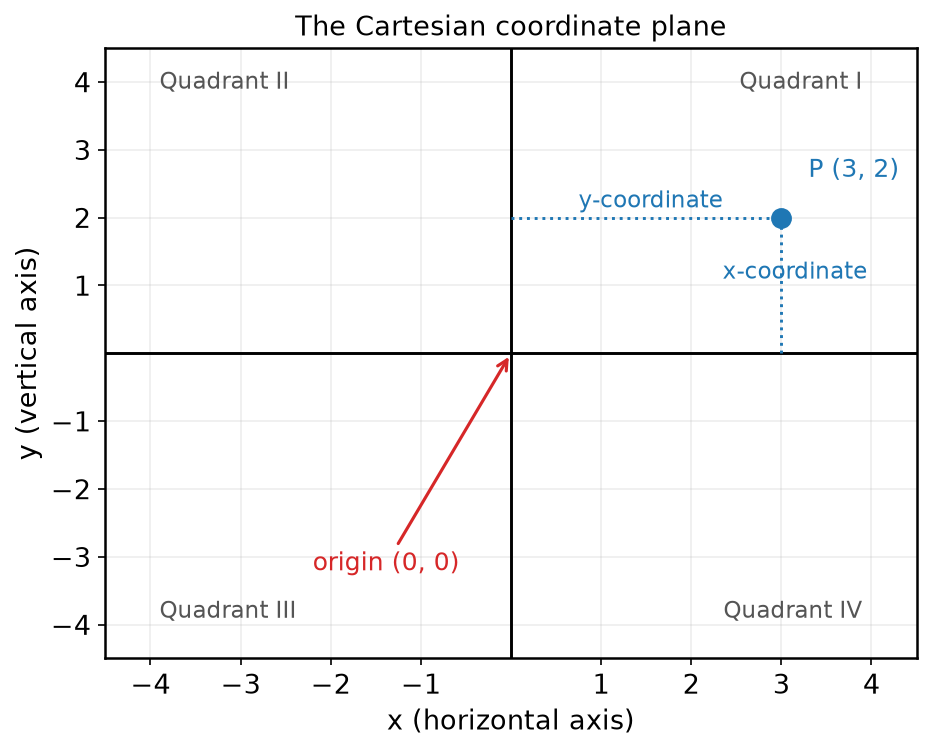
The plane is described by two perpendicular number lines: the x-axis (horizontal) and the y-axis (vertical). They meet at the origin, the point (0, 0). Any point is written as an ordered pair (x, y): the x-coordinate first, then the y-coordinate.
Read it aloud: "Point P has coordinates three comma two." — note that in English we say "three comma two", not "three two".
2. The equation of a straight line
The most common form of a line's equation is the gradient–intercept form:
y = mx + c
Read it: "y equals m x plus c."
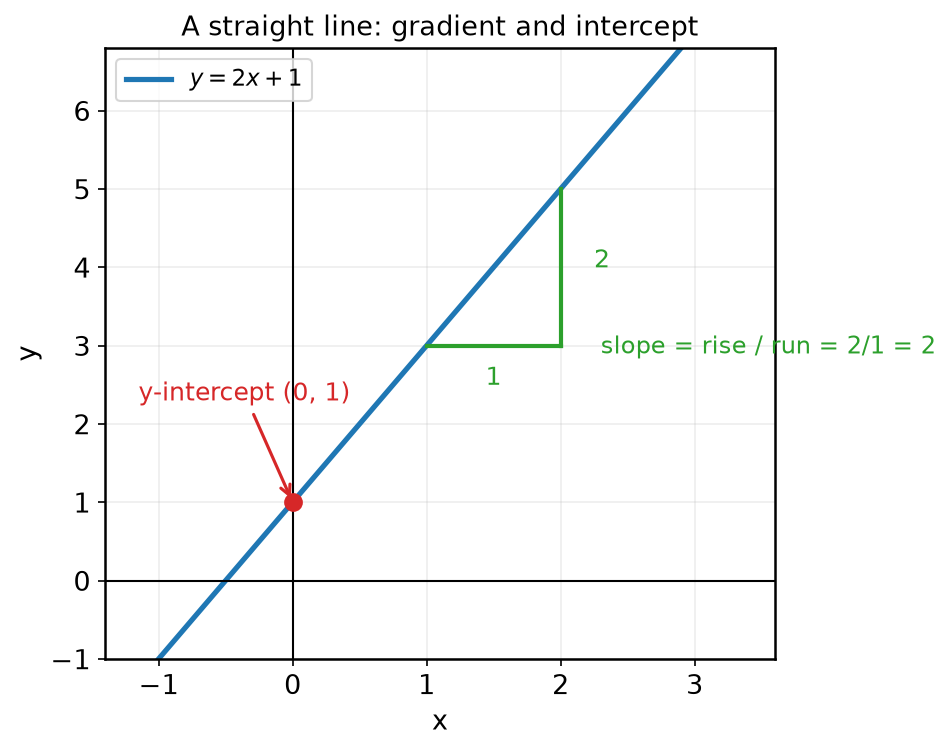
- m is the gradient (also called the slope in American English) — how steep the line is.
- c is the y-intercept — where the line crosses the y-axis, i.e. the value of y when x = 0.
The gradient is the ratio of the rise to the run: how far the line goes up for every unit it goes right. Read it: "the slope equals the rise over the run."
The gradient from two points
If a line passes through two points (x₁, y₁) and (x₂, y₂), its gradient is
m = (y₂ − y₁) / (x₂ − x₁)
Read it: "m equals y two minus y one, over x two minus x one." — pronounced "y two", "x one", not "y subscript two".
3. Parallel and perpendicular lines
- Parallel lines have the same gradient: if m₁ = m₂, the lines never meet.
- Perpendicular lines have gradients that are negative reciprocals: m₁ · m₂ = −1. Read it: "the product of the two gradients is minus one."
4. The distance between two points
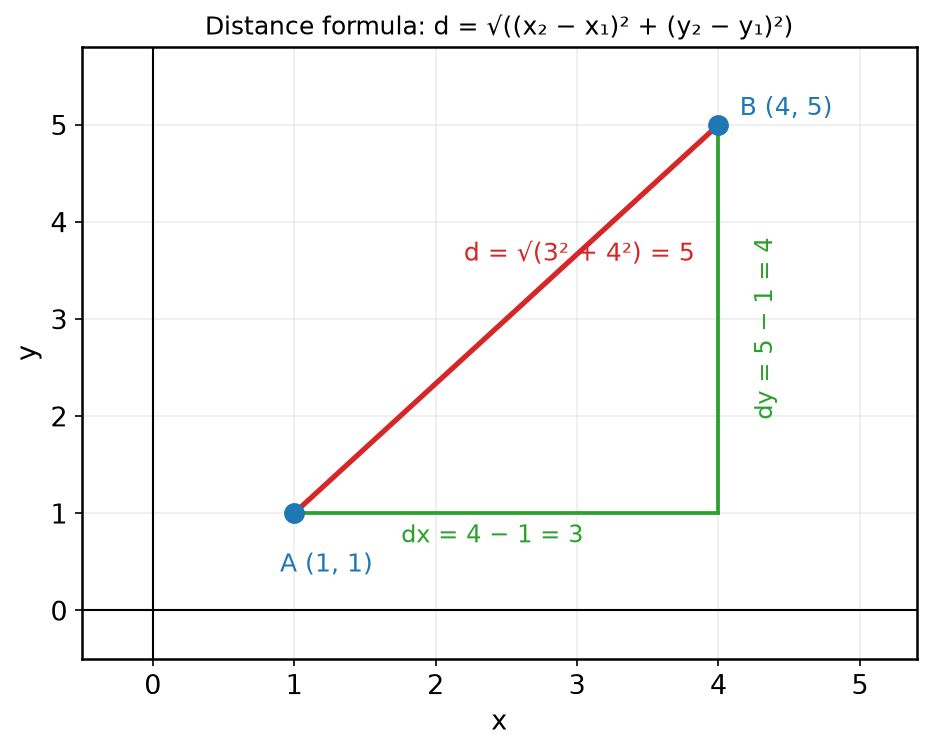
Given two points, the straight-line distance between them comes from Pythagoras' theorem:
d = √((x₂ − x₁)² + (y₂ − y₁)²)
Read it: "d equals the square root of x two minus x one, squared, plus y two minus y one, squared."
Think of it as a right-angled triangle: the horizontal gap is (x₂ − x₁), the vertical gap is (y₂ − y₁), and the distance is the hypotenuse. Read it: "the horizontal difference" and "the vertical difference".
5. The midpoint
The midpoint of the segment joining two points is the average of their coordinates:
M = ( (x₁ + x₂)/2 , (y₁ + y₂)/2 )
Read it: "M equals x one plus x two over two, y one plus y two over two." The midpoint bisects the segment — it divides it into two equal halves.
6. The equation of a circle
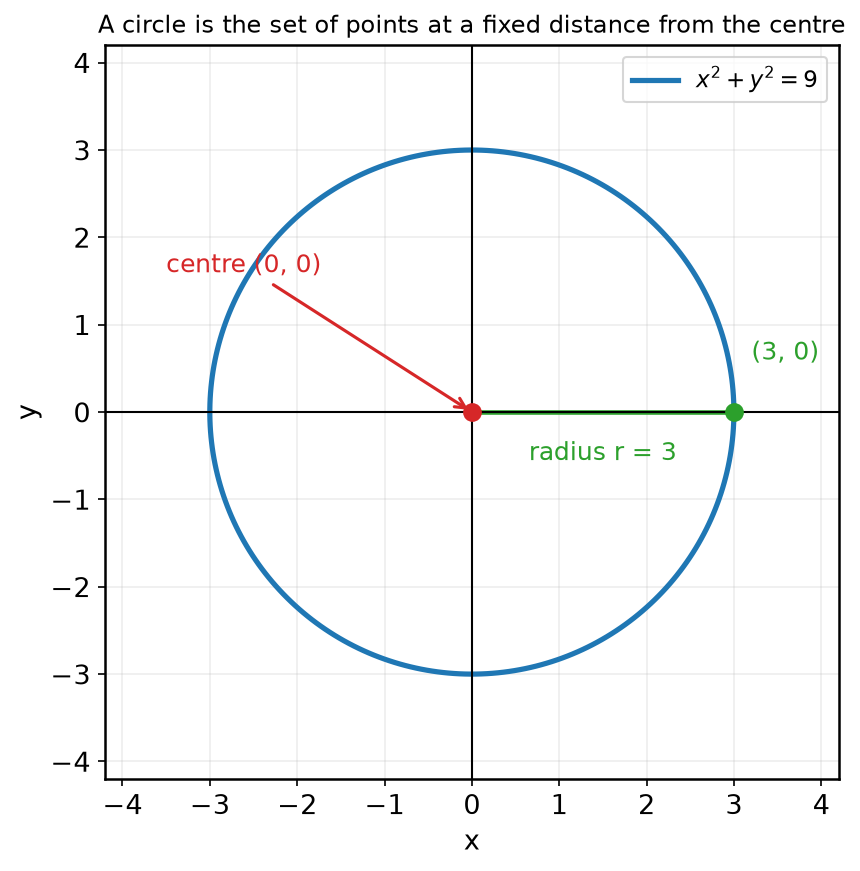
A circle is defined as the set of all points at a fixed distance — the radius — from a fixed point, the centre. For a circle centred at the origin with radius r:
x² + y² = r²
Read it: "x squared plus y squared equals r squared."
More generally, a circle with centre (a, b) and radius r is:
(x − a)² + (y − b)² = r²
Read it: "x minus a, squared, plus y minus b, squared, equals r squared." — This is the standard form of a circle's equation. You can always tell a circle from an equation: the x² and y² terms have equal coefficients and there is no xy term.
7. Tangents to a circle
A tangent is a line that touches the circle at exactly one point — the point of tangency. The tangent is always perpendicular to the radius drawn to that point. Read it: "The tangent is perpendicular to the radius at the point of contact."
8. Why coordinate geometry matters
Coordinate geometry is the bridge between algebra and geometry: it lets us represent shapes with equations and solve geometric problems with arithmetic. In English science writing, this subject appears in surprising places:
- Physics — the path of a projectile is a parabola in coordinates; velocity and acceleration are slopes of graphs.
- Computer graphics — every image on a screen is a grid of points with coordinates; lines and circles are drawn by their equations.
- Economics — supply and demand curves are graphed on coordinate planes; the equilibrium is their intersection point.
9. Quick check — test yourself
- What are the gradient and y-intercept of y = −3x + 5? In what direction does the line slope?
- A line passes through (1, 2) and (4, 8). Find its gradient. Is it steeper or less steep than y = 2x?
- Give the centre and radius of (x + 1)² + (y − 4)² = 25.
- Translate into English: "这条直线与 x 轴平行,因此它的斜率为零。"
Answers: 1. m = −3, c = 5; the line slopes downward (negative gradient). 2. m = (8−2)/(4−1) = 6/3 = 2; it has the same steepness as y = 2x. 3. Centre (−1, 4), radius 5. 4. "This line is parallel to the x-axis, so its gradient is zero."
10. Vocabulary recap
| Term | Meaning |
|---|---|
| coordinate plane / Cartesian plane | the grid formed by two perpendicular axes |
| origin | the point (0, 0) where the axes meet |
| ordered pair | a point written as (x, y) in that order |
| gradient / slope | steepness: rise over run |
| intercept | where a line crosses an axis |
| parallel | never meeting; same gradient |
| perpendicular | at right angles; gradients multiply to −1 |
| midpoint | the point halfway between two points |
| bisect | divide into two equal parts |
| radius (plural: radii) | the distance from the centre to the circle |
| tangent | a line touching the circle at one point |
| secant | a line cutting the circle at two points |
| hypotenuse | the longest side of a right-angled triangle |
No comments yet.