Natural Sciences in English · 03
Trigonometry: Sine, Cosine and Tangent — triangles, the unit circle, and waves
Why this lesson? You know 三角函数 from Chinese class. This lesson gives you the English: how to say "sine of thirty degrees", how to name the sides of a triangle, and why sin, cos and tan appear in everything from waves to navigation.
1. Naming the sides of a right-angled triangle
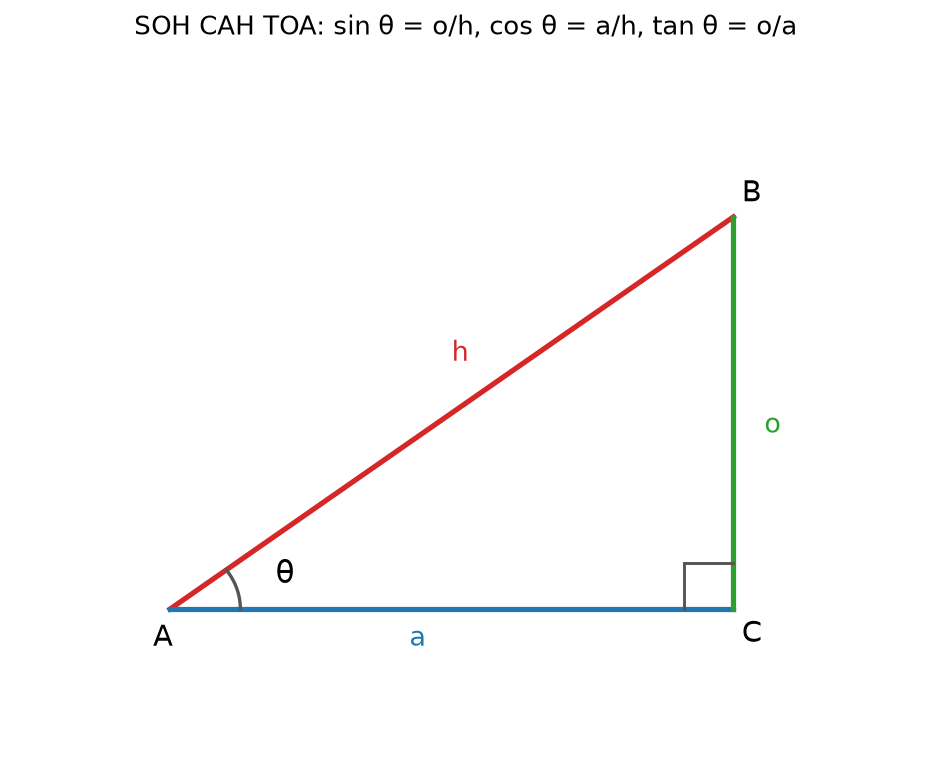
Take a right-angled triangle with an angle θ (theta). Relative to θ, the three sides have fixed names:
- The hypotenuse — the longest side, always opposite the right angle (the Greek word hypoteinousa means "stretching under").
- The opposite side — the side across from θ, which does not touch θ.
- The adjacent side — the side next to θ, which, together with the hypotenuse, forms the angle.
2. The three basic ratios — SOH CAH TOA
The three trigonometric functions are defined as ratios of sides. The mnemonic SOH CAH TOA is used in every English-speaking classroom:
SOH:  sin θ = Opposite / Hypotenuse
CAH:  cos θ = Adjacent / Hypotenuse
TOA:  tan θ = Opposite / Adjacent
Read each line: "sine theta equals opposite over hypotenuse", "cosine theta equals adjacent over hypotenuse", "tangent theta equals opposite over adjacent". The word "over" means division.
3. Special angles worth memorising
| Angle | sin | cos | tan |
|---|---|---|---|
| 0° | 0 | 1 | 0 |
| 30° | 1/2 | √3/2 | 1/√3 |
| 45° | √2/2 | √2/2 | 1 |
| 60° | √3/2 | 1/2 | √3 |
| 90° | 1 | 0 | undefined |
Read them: "sine of thirty degrees is one half", "cosine of forty-five degrees is root two over two", "tangent of ninety degrees is undefined". Note: in English we always say the function name first — "sine of x", not "x's sine".
4. The unit circle — trigonometry beyond triangles
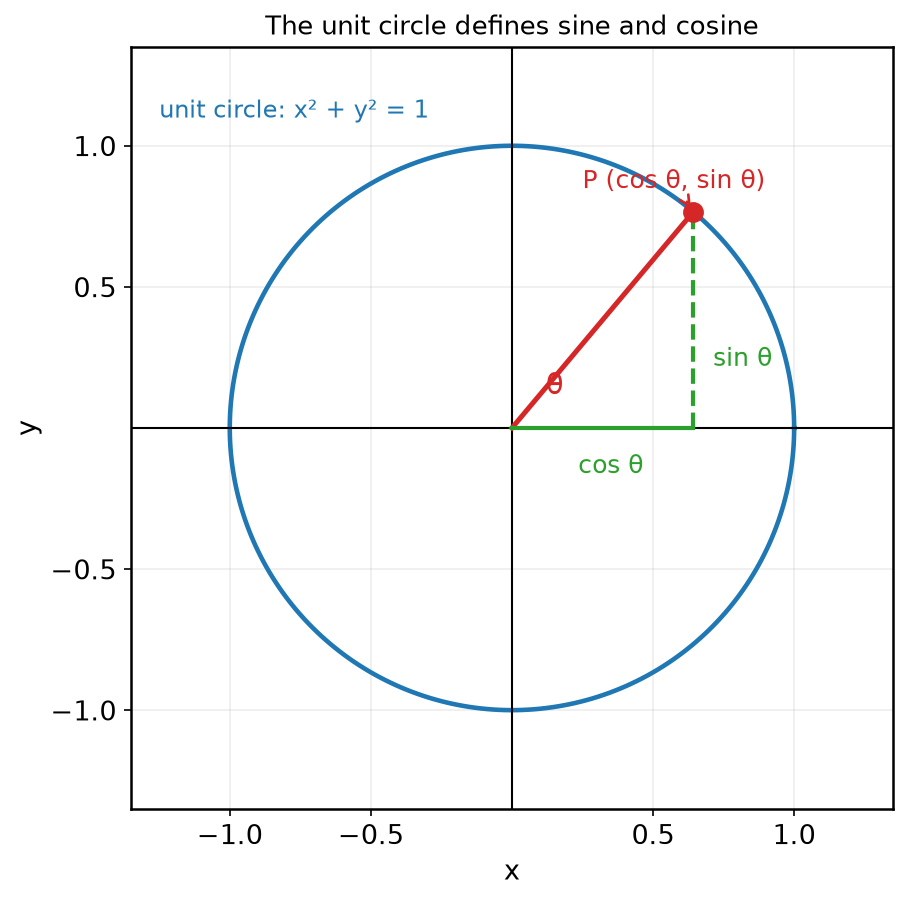
Angles bigger than 90° cannot fit in a right triangle, so we extend the definitions using the unit circle: the circle of radius 1 centred at the origin. For any angle θ, draw a radius making angle θ with the positive x-axis. Then:
cos θ = x-coordinate, sin θ = y-coordinate, tan θ = y / x
Read it: "On the unit circle, cosine theta is the x-coordinate and sine theta is the y-coordinate."
5. The graphs of sine and cosine
Plotting sin x and cos x against x reveals that both are periodic — they repeat every 2π (360°). Read it: "Sine and cosine are periodic functions with period two pi."
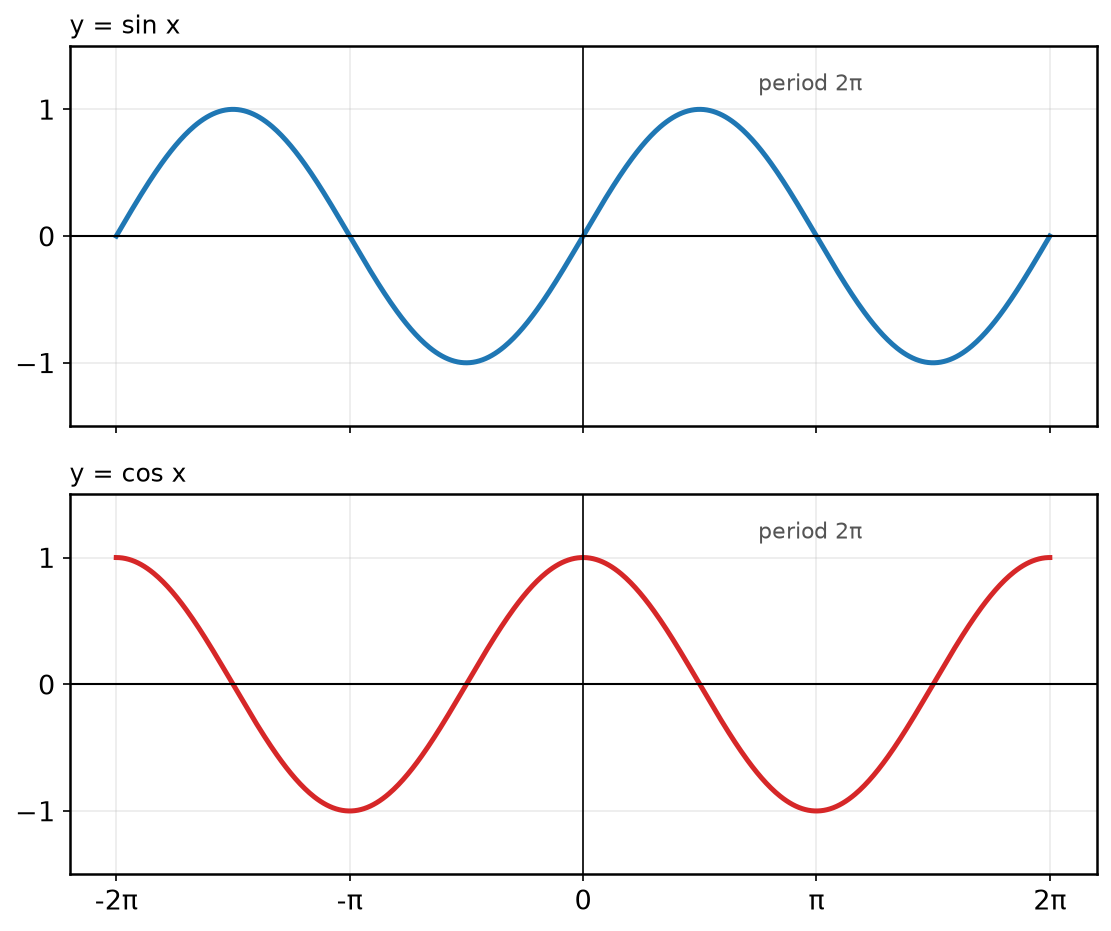
- The amplitude is the maximum distance from the middle line — for sin x and cos x it is 1.
- The period is the length of one full cycle — for sin x and cos x it is 2π.
- cos x is sin x shifted to the left by π/2: read it, "cosine x equals sine of x plus pi over two."
6. The sine rule and cosine rule
For triangles that are not right-angled, we need two powerful tools. In any triangle with sides a, b, c opposite angles A, B, C:
The sine rule (正弦定理):
a / sin A = b / sin B = c / sin C
Read it: "a over sine A equals b over sine B equals c over sine C."
The cosine rule (余弦定理):
c² = a² + b² − 2ab cos C
Read it: "c squared equals a squared plus b squared minus two a b cosine C." Note that when C = 90°, cos C = 0, and the cosine rule becomes Pythagoras' theorem — read it: "the cosine rule generalises Pythagoras' theorem."
7. Where trigonometry appears in real life
- Navigation — ships and aircraft use trigonometry to compute bearings and distances.
- Waves and sound — sound, light and radio waves are described by sine functions; read it: "A wave can be modelled by y = A sin(2πft + φ)."
- Physics — resolving a force into components uses sin and cos; read it: "The horizontal component is F cosine theta; the vertical component is F sine theta."
- Architecture — calculating roof slopes and support angles.
8. Worked example — full English solution
Problem. In a right-angled triangle, the hypotenuse is 10 and one angle is 30°. Find the opposite side.
Solution. Read it aloud:
sin 30° = opposite / hypotenuse
opposite = 10 · sin 30° = 10 · 1/2 = 5
"Sine of thirty degrees equals opposite over hypotenuse. Therefore the opposite side equals ten times sine thirty degrees, which is ten times one half, which is five." — the phrase "therefore" and the verb "equals" are the skeleton of every English maths solution.
9. Quick check — test yourself
- In a right triangle, cos θ = 0.6. What is sin θ, given the identity sin²θ + cos²θ = 1?
- What is the period and amplitude of y = 3 sin(2x)?
- The sine rule relates which pairs of quantities?
- Translate into English: "正切函数在九十度处无定义。"
Answers: 1. sin θ = √(1 − 0.36) = √0.64 = 0.8. 2. Amplitude 3, period π (because period = 2π/2). 3. Each side with the sine of its opposite angle. 4. "The tangent function is undefined at ninety degrees."
10. Vocabulary recap
| Term | Meaning |
|---|---|
| trigonometry | the study of triangles and angles; Greek "triangle measure" |
| hypotenuse | the longest side, opposite the right angle |
| opposite / adjacent | across from / next to the angle |
| ratio | a comparison of two quantities by division |
| unit circle | the circle of radius 1 centred at the origin |
| periodic / period | repeating at regular intervals / the length of one cycle |
| amplitude | maximum distance from the middle line |
| radian | the angle whose arc length equals the radius |
| sine rule / cosine rule | formulas for solving non-right triangles |
| component | one part of a vector along an axis |
| mnemonic | a memory aid, e.g. SOH CAH TOA |
No comments yet.